


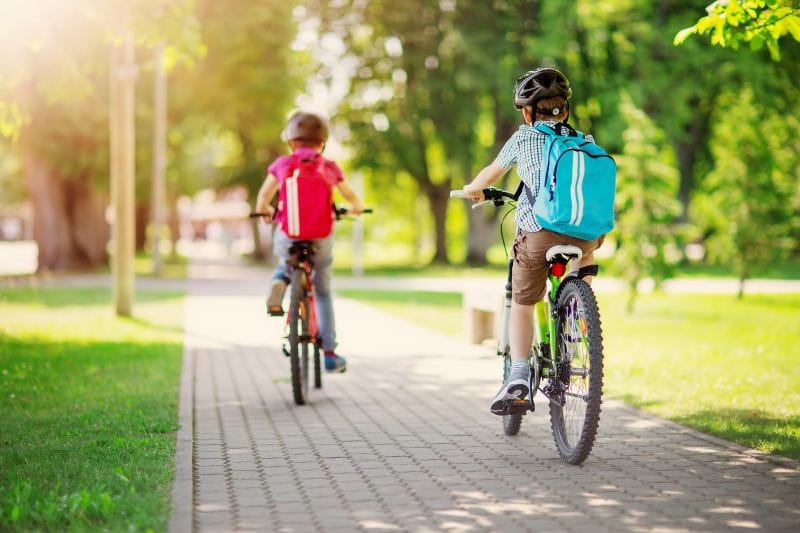
The Dangers of Kids and High Speeds, No Helmets
BayCare Kids Wellness and Safety Experts want parents to take a serious look at e-bike and e-scooter safety
There’s a new menace on the road, and chances are, you’ve already looked at one and thought, “That looks like fun!”
Before adding that electric bike or scooter to your shopping cart, however, BayCare Kids Wellness and Safety Specialist Gina Baez would like you to ponder this statistic: Just in the last year, there has been an 80% increase in e-bike and e-scooter injuries.
“What we’re seeing with e-bikes and e-scooter is that parents aren’t really knowledgeable about what they are putting their kids on,” Baez says. “And it’s really important that we call attention to that.”
The average age of children injured in e-bike and e-scooter accidents is 10-12, and most show up at the ER with limb and head injuries. Fatalities have also occurred. There is a steep increase in injuries during summer months and school breaks.
Parents often have no idea how fast their children will be going on these gadgets. There are three different classes of e-bikes, Baez explains. Class 1 has pedals, while Class 2 has a throttle and goes up to 20 mph. Class 3 e-bikes can go up to 28 mph, but she has seen instances where owners have tampered with the bikes to make them go faster — up to almost 60 mph.
Another problem? “We’re seeing no helmets,” Baez says. A regular bike helmet isn’t enough to protect a child at these speeds. Baez wants parents to read product descriptions to ensure that the helmets they purchase for use are e-bikes and e-scooter certified and consumer safety recommended.
Many e-bike and e-scooter riders also do not really follow rules of roads, Baez says. She often sees them going the wrong way, running stop signs, turning without looking and riding without awareness of pedestrians.
She’s also seen children putting friends on the back of their scooter, which poses a whole other set of risks.
Recently, Florida Governor Ron DeSantis vetoed a bill that would have established statewide rules mandating that e-bike riders on shared pathways must yield to pedestrians and give an audible signal before overtaking and passing a pedestrian, and that e-bikes cannot be driven faster than 10 miles per hour if a pedestrian is within 50 feet.
The bill also sought to establish a task force to collect data to study e-bike and e-scooter safety.
“We just want to educate parents and children,” says Baez.
There’s one other reason that Baez wishes parents would think twice before purchasing these, especially for younger children under 12.
“We want physical activity,” she says. “If we’re not pedaling, you’re not getting physical activity.”
However, if parents really want to purchase an e-bike or e-scooter, she hopes they will also purchase the right type of helmet and educate their children on the rules of the road and safe riding
“It’s really important to bring attention to the issues,” Baez says.
GENERAL TIPS FOR TEACHING ROAD SAFETY
Pedestrian Safety
- Teach kids to look “left, right and left again” from the earliest age that they can understand.
- When strolling down sidewalks, train your child to pause before driveways and make sure no one is backing out or driving in.
- When crossing a street, use signals and crosswalks.
- If a driver pauses at the crossing to let you walk, make eye contact to ensure they see you.
- Don’t be a distracted pedestrian. Take out the earbuds, put down the phone and pay attention to the road.
- Walk on the opposite side of the traffic so that you can see cars approach your side of the road.
Bike Riders
- Wear a helmet if you are using any wheels, whether that be a bicycle, tricycle, skateboard, hoverboard or scooter. A correct fit is essential.
- Ride on the sidewalk, but unlike when you’re a pedestrian, ride with the flow of traffic instead of on the opposite side.
- Follow the rules of the road and use hand signals when turning.
- Try and be clearly visible by wearing bright colors, using lights early in the morning or adding reflectors to a helmet.
Drivers and Parents
- Share the road!
- Be aware of school start and end times, especially as the days get shorter and the sun rises later.
- Put down the cell phone.