


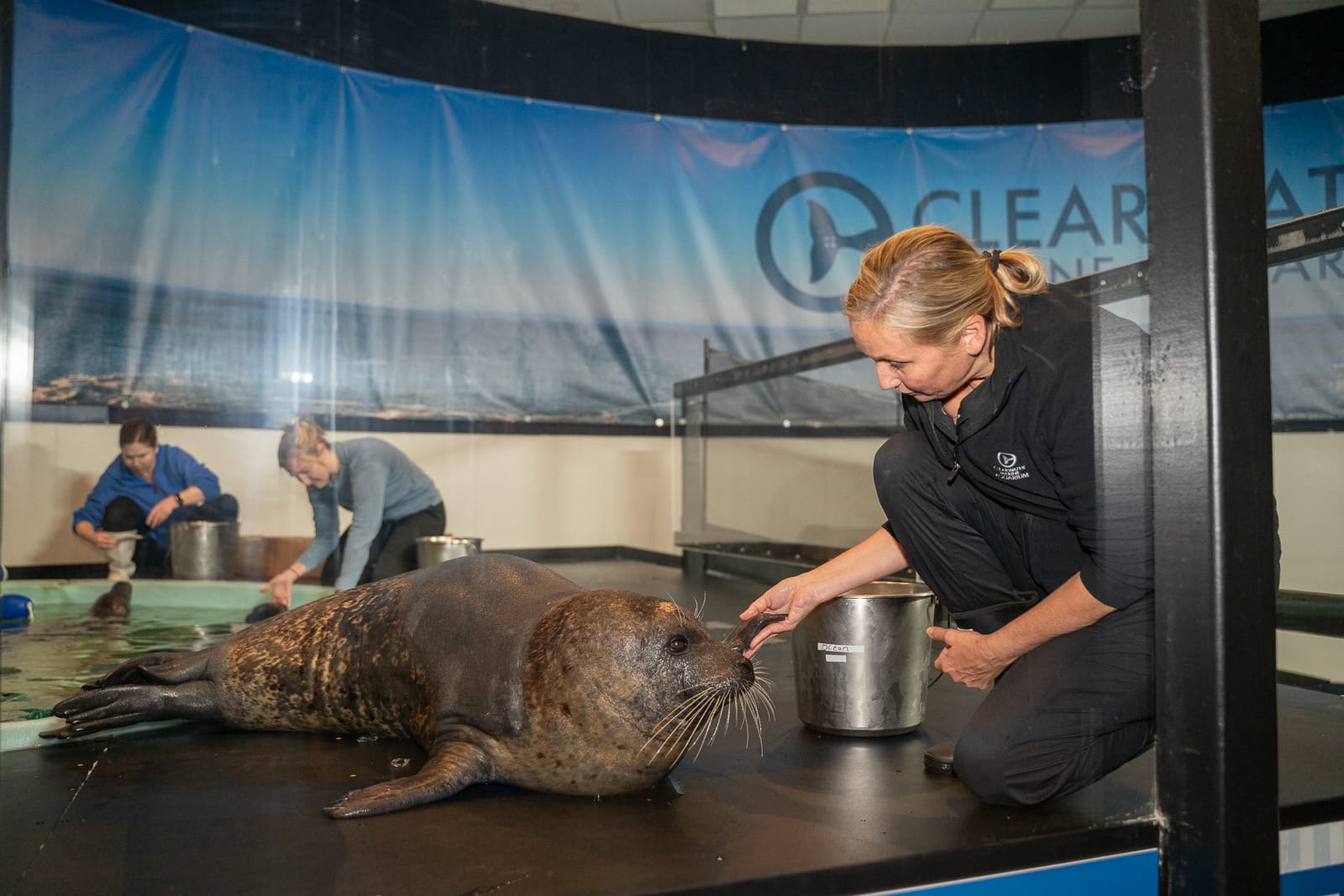
Clearwater Marine Aquarium welcomes three adorable harbor seals!
There’s big news out of Clearwater Marine Aquarium (CMA)! The team recently welcomed a brand-new species to CMA and to the Tampa Bay Area with the addition of three adorable harbor seals.
The animals are coming from The Miami Seaquarium, and because they were born under managed care, they cannot be released into the wild. This is why they’re making their forever home here at Clearwater Marine Aquarium.
And soon, they’ll be joined with additional pinnipeds, sea lions, that will move into a new habitat under construction now and scheduled to open this summer.
We met up with Cammie Zodrow, CMA’s Animal Care Program Manager, to learn more about these incredible animals, as we got to meet the seals for the first time.
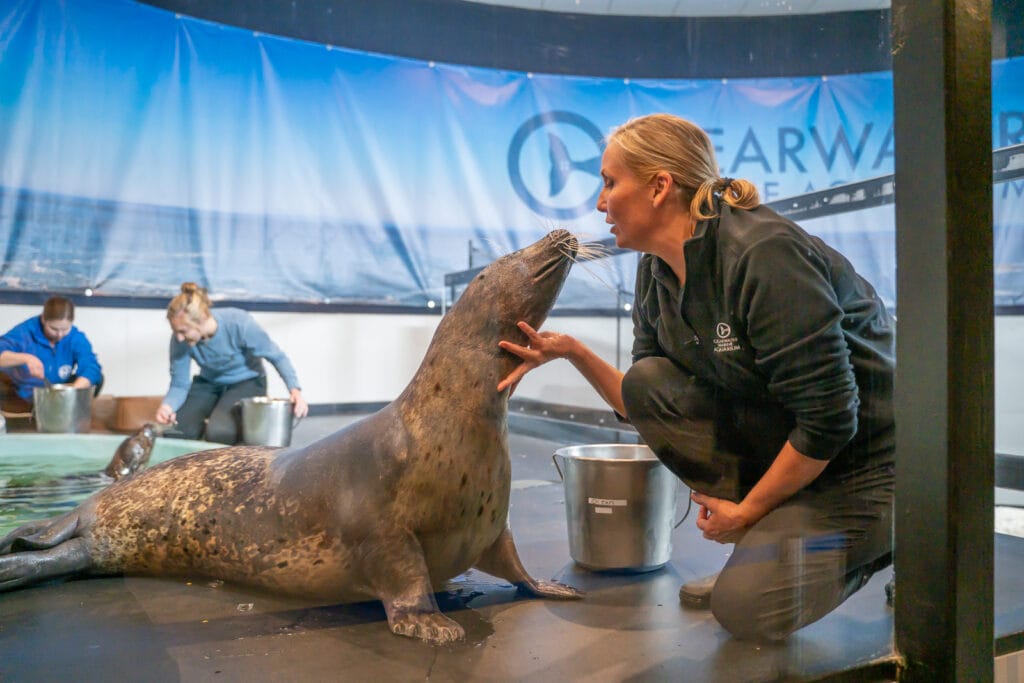
LB: Cammie, can you tell us more about these amazing animals? We see one already coming up to us at the window!
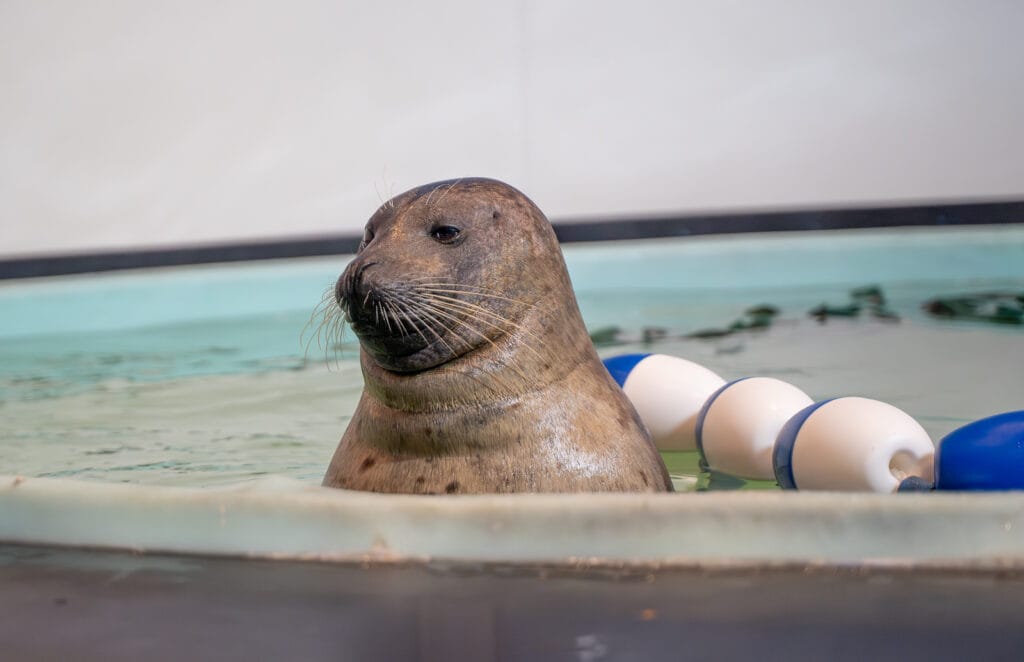
CZ: So this is Ocean. She is one of three brand-new harbor seals here at Clearwater Marine Aquarium. She is the oldest harbor seal that we have. She's 12 years old. Next to her is Scallop. She is 10 years old, and Pharaoh is also 10 years old, and she's swimming in the pools.
These guys are native to the Pacific side of the United States, almost all the way down to Mexico. You can also find them on the eastern seaboard of the United States. They do prefer colder water, but you can find them all over the world. They are common species of penniped.
LB: What are their personalities like?
CZ: Ocean is the more dominant, and you could see she was probably the most confident out of all of the harbor seals. Scallop, she’s very curious also, so she's sort of hanging out watching us. And Pharaoh, she likes to explore different things in her environment.
Personality-wise, they're all very, very mellow and relaxed, and they have made this experience so easy and wonderful.
LB: The harbor seals are a new species for CMA, and for you. I'm sure that's so exciting for the team.
CZ: Yes. I am beyond thrilled for this opportunity, not only for the aquarium, the staff, the volunteers, all of our interns here, but for our guests. This is going to be an extremely memorable exhibit and experience for them. You can see how close they're coming to the windows.
I just can't wait for people to come and see them and see what we've been seeing.
LB: Their arrival here really does represent the mission here at CMA of rescue. While you all do focus on rehab and release as well, what makes this place so special is that it can also become a forever home for animals that cannot be released.
CZ: Rescue takes shape in many different forms. These girls were brought in from a facility [The Miami Seaquarium] that could no longer keep them. They needed to be rehomed immediately, and we opened our arms right away without hesitation to bring them in.
It’s a new species for us. It’s a new opportunity for this area and for our guests to be able to experience something magical.
LB: Any tips for families on when they should come visit the harbor seals?
CZ: Currently, we have three feeding schedules for them. They get their breakfast in the morning. We will interact with them again around noon and then around 4 o’clock. We plan on having a little informative presentation at the same time.
When you come here, it's always best to do research online, plan your schedule, and see how everything you want to see is going to fit into that.
We tried to schedule them be the opposite of our dolphin presentations, so you can see both. You can come see the dolphins and then come down here to see our harbor seals. This exhibit will be open outside of the presentation time.
So even though we're not in here interacting with them, the experience can still be had. Your kids are going to have an up-close child's eye view. It’s perfect kid size. It is really a perfect opportunity to view them so close.
LB: Why do you think it’s so important for us to bring our kids here to experience exhibits like this?
CZ: A huge part of our mission here is to educate and inspire our guests to take the messages here and apply them to their daily lives. My children were fortunate enough to grow up with all of this. So for me to be able to introduce my world to your children, it's just a great opportunity.
Your kids learn to love and appreciate when they get to see the animals and have memorable moments, things that they can reflect back on in their lifetime. Like, hey, I saw a harbor seal, and it was breathing, and it made a little heart on the glass, or that animal made eye contact with me. Those are moments that, as a parent, are sometimes irreplaceable.
And what we offer at the aquarium is a very powerful message of conservation and education, as well as connection and inspiration.
I would love for a million little Cammies to pop up and love these animals as much as I do to take my place. So we need people to fill in those gaps, and children are a great way to start.
LB: What’s your advice to kids out there who want to do what you do when they grow up? Obviously, booking a summer camp here is a great start!
CZ: I believe in following your passion. This is not just a job. I say it's a lifestyle. We are here 24 hours a day, seven days a week. But stay in school. We look for people who have, when I hire, people who have psychology backgrounds because we do a lot of shaping behavior to allow these animals to be successful under human care for the rest of their lives. So we want them to think that we're great.
We want them to hang out with us and be comfortable with everything that we do. So follow your passions, become educated.
Internships are a great way to get those experiences under your belt because you wanna make sure that you're a great fit, because happy humans make happy trainers, which translates to happy animals.
Related: Learn more about the Marine Science Summer Camp at Clearwater Marine Aquarium
LB: And soon you'll welcome sea lions, another new species for CMA!
CZ: What I appreciate is that we have held true to our mission of rescue and rehabilitation and providing forever homes, education, and conservation. But the opportunity to bring in new inspiration has just been, I think, a breath of fresh air.
We have new dolphins here. We also have four new rough-toothed dolphins and two new bottlenosed dolphins. I think it’s just infused a new energy into the building. We've been doing previews for our staff, and to hear them squeal and get excited about seeing them.
I'm so excited for our guests to be able to have that same reaction.
LB: Have your kids been here yet?
CZ: So my oldest son is now 21. He's, he's in the Navy, so he's lived this life. My youngest son is 17, and he has grown up, both of them have grown up in this world. Off this topic, he has a small reptile rescue. So one of my kids has followed directly in my footsteps.
But he's not even seen them yet because they've gone through a quarantine that's been pretty strict to follow. And we're at the light at the end of the tunnel with that. So it'll be nice for him to see them. He'll fall in love with them. Everybody has fallen in love with them once they see their faces.
LB: And as a mom, when you see kids connect to animals like these seals, it must be a special feeling.
CZ: It is. And it's accessible to everyone, which is also very important. We, as a staff, are accessible to our guests, and the animals are as well. And to have that accessibility safely with the educational message, it is just, I think, a really nice environment to bring your children and see the magic and wonder in their faces when they're seeing them for the first time. I mean, that's just a gift. It really is a gift for parents.
LB: Anything else you want to add?
CZ: They’re great. They really are great. It's been a pleasure getting to know them, getting, and we're continuing to get to know them. And I'm really excited for the future of the aquarium and for these girls.
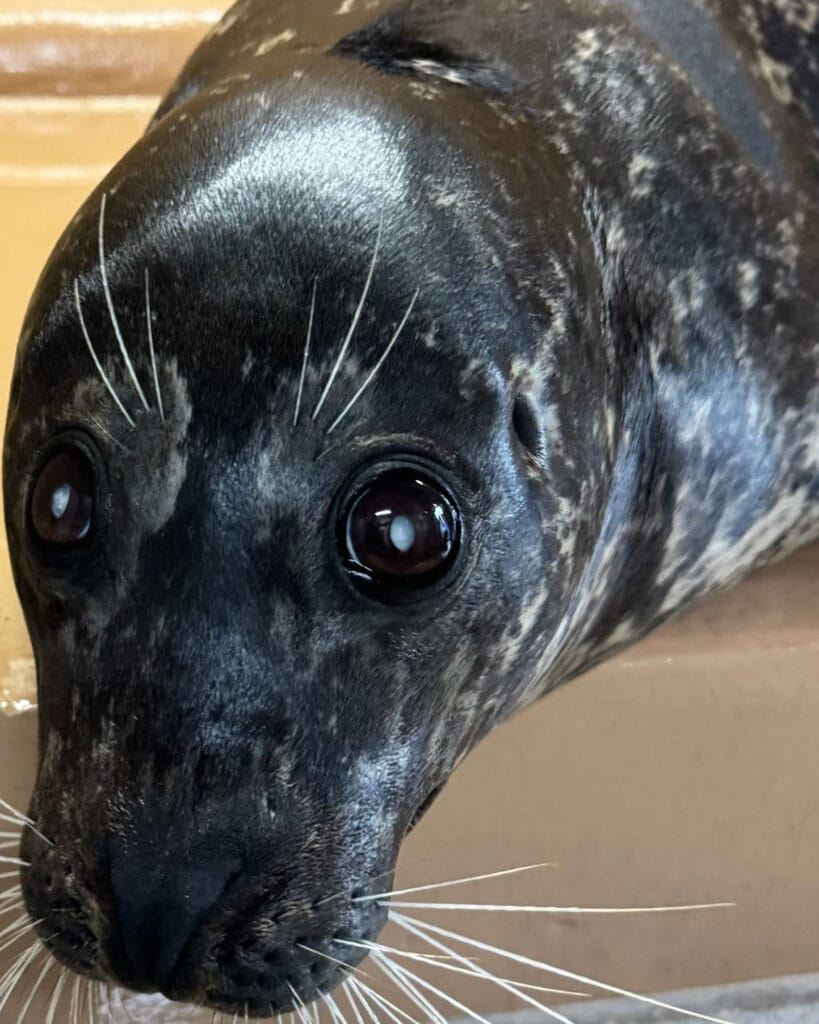
A closer look at the new harbor seals at Clearwater Marine Aquarium:
- Scallop, 10, uses all aspects of her habitat on land and in water. With large, round eyes and a rounded body, Scallop prefers to eat underwater and skillfully uses her sensitive whiskers, known as vibrissae.
- Pharaoh, 10, is darker in coloration with distinctive light mottling and “eyebrow” markings. She prefers relaxing in the pool and is known affectionately as the group’s “Ice Queen” for her love of ice enrichment.
- Ocean, 12, is the largest of the three females. Lighter in color with smaller eyes, Ocean is also the most vocal, using front-flipper movements to communicate.
The refurbished habitat space for the pinnipeds was made possible through a $6 million grant from the Tourism Development Council, approved by the Pinellas County Board of County Commissioners.
Facts about harbor seals from CMA:
- Harbor seals (Phoca vitulina) are found across coastal waters of Alaska, New England, the Mid-Atlantic, Southeast and West Coast of the United States, as well as the northern coasts of Europe and Asia.
- They typically live 20–30 years in the wild and can live up to 50 years under human care. Adults can reach up to 300 pounds and measure five to six feet long. Each seal has a unique pattern of spots—much like a fingerprint—and is easily identified by their rounded heads, V-shaped nostrils, large eyes, lack of external ear flaps, and distinctive claws used for grooming, gripping, and efficient movement on land and in water.
- Pinnipeds face threats including pollution, toxins, habitat loss, vessel strikes, harassment, and prey loss due to overfishing. While harbor seals are currently listed as a species of Least Concern overall, some populations are endangered in certain regions, making education and conservation awareness critical.
View this post on Instagram