

INSIDE LOOK: ZooTampa Veterinarian Healing Zoo Animals with Acupuncture
Acupuncture on a duck… or a manatee? You betcha! ZooTampa's veterinary team is incorporating this holistic approach to care for animals that may not be responding as well to traditional treatments, and it appears to be working.
I didn't even know this was a thing until I took part in one of the Zoo's new Inside Look Tour: Animal Health experiences, and our group watched as a roseate spoonbill chick received an acupuncture treatment on a limb that had limited movement. It seemed a little woo-woo science, but it turns out there's something to it.
Fast forward a couple of months, when I returned to the Zoo to meet up with the veterinarian leading this program, I found out that the spoonbill is doing great and was able to recover full movement of its limb with the help of medicine, physical therapy, and yes, acupuncture. Pretty cool, right?
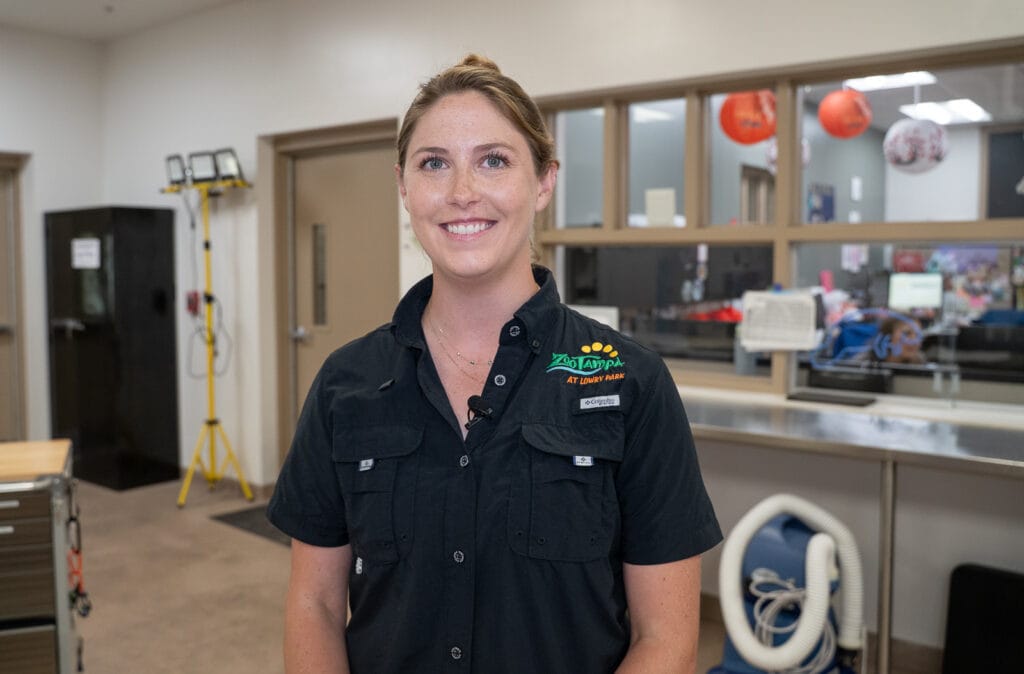
We recently met up with the veterinarian who is taking the lead on this program, Dr. Alex Mason, DVM, MS, CVA, CertAqV, to learn more about the acupuncture program at the zoo and how it's changing the lives of the animals in its care.
INSIDE LOOK: Acupuncture at ZooTampa
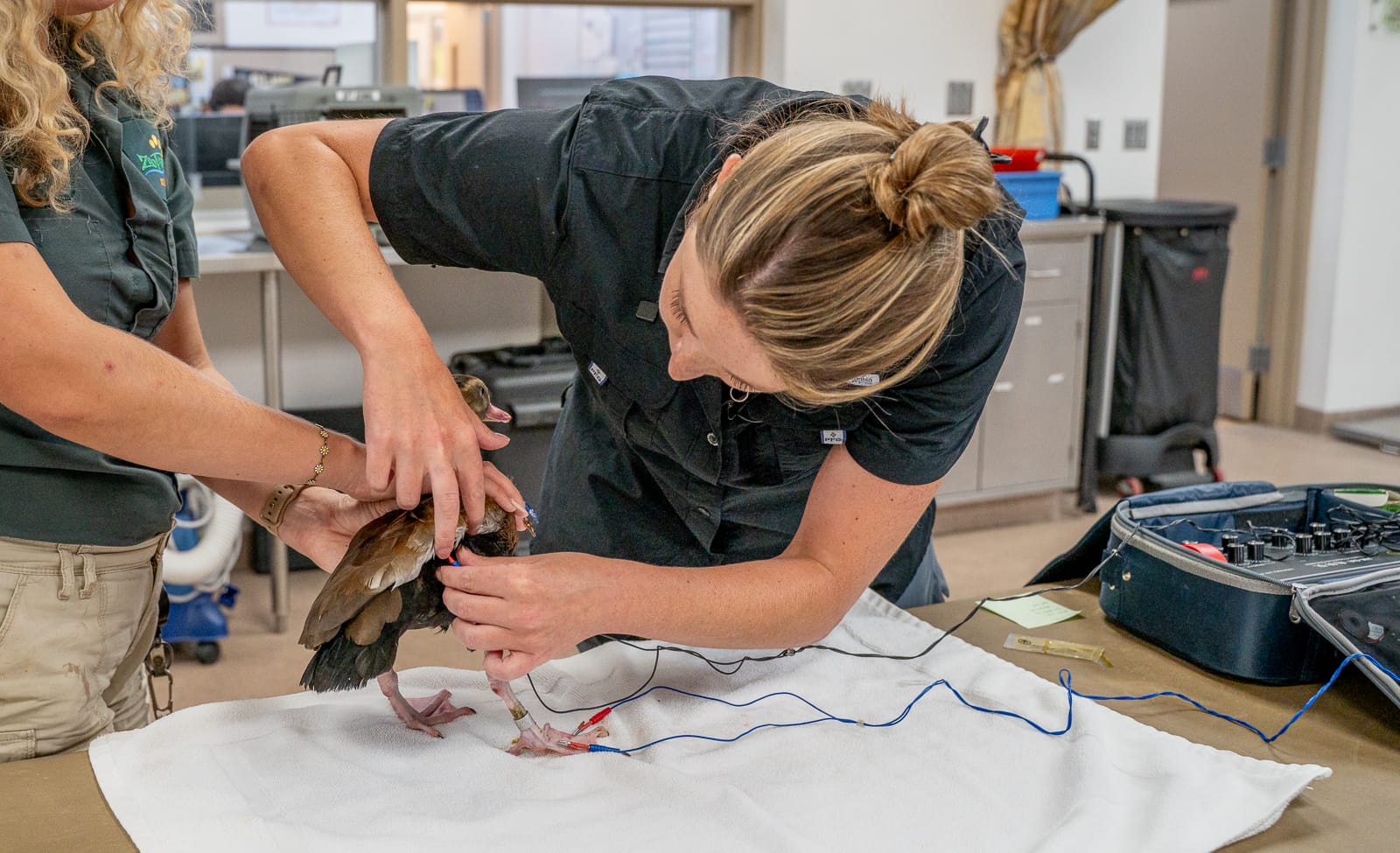
We interviewed Dr. Mason as she treated Earl Grey, a 14-year-old black-bellied whistling duck that experienced sudden weakness in its leg. Despite a full workup of X-rays and a physical exam, the veterinary team was not able to determine the cause.
And while they did start him on medications for pain, Dr. Mason also began to treat him using electroacupuncture to help manage the pain and stimulate the nerves for better movement. And it worked…
TBPM: How has Earl Grey responded so far to the acupuncture treatments?
Dr. Mason: He tolerates it well. We can see that he's placing his feet appropriately, and that's actually improved from when he presented, when he would kind of knuckle the foot under. So this is already looking better compared to the last time I saw him.
TBPM: As you place the acupuncture needles, can you explain the process?
Dr. Mason: I try to just make it as stress-free as possible. So Maya is just very lightly restraining him. If at any time he does get more stressed, we'll discontinue. But he traditionally has tolerated this very nicely. So I'm going to go ahead and stick my first one. The right leg has been the leg of focus, so most of my points are going to be focused on that right leg. So I'm just going to do some points that target for weakness.
I'm going to go between the toes. Okay, so that's three needles in.
Now I'm going to go up onto kind of the knee area and do a really good point just for general pain relief, improving energy, and then I'm going to try to hook that up to a point up on his hip that will help run an electrical current through those areas and again just help even better stimulate the nerves.
I'm actually going to stick one on the back of his right foot too, just kind of right underneath that foot pad. And these points are targeted at improving, so these are aimed to help with general weakness and again stimulate those nerves and kind of bring the energy into that leg and improve the mobility.
TBPM: For someone who may have never experienced acupuncture, how big are the needles and does it hurt?
Dr. Mason: The needles I'm using are called Korean hand needles, so they're tiny. You can see that's smaller than any needle we would use to administer medication, and they’re actually solid all the way through, so they're not hollow, so you're not causing more tissue damage. Really, it's very painless; it kind of just feels weird going in.
TBPM: How do you figure out where to place the needles since animal anatomy can vary species to species?
Dr. Mason: Basically, I'm trying to palpate on him and actually feel anatomically where my points are. So you have to have a good understanding of anatomy to be able to do acupuncture, to be able to then even apply those points on a bird that has different anatomy than, say, a dog or a horse that we are traditionally taught on. So it definitely brings a fun challenge into it.
TBPM: Do you find that adding electroacupuncture helps?
Dr. Mason: While the needles alone are also giving him treatment, this makes my treatment last longer and gives a little bit more bang for our buck, especially in terms of releasing the healing factors and bringing stem cells and blood flow to the areas that we really want to stimulate, in addition to stimulating those nerves. So I really like to use it on animals that tolerate it well.
TBPM: How does it work?
Dr. Mason: This is basically going to run an electrical current between the two points that I've connected and I can control the frequency of my pulse in addition to the intensity of it. So I'll always start low, and then I watch my patient as I turn it up and just make sure as I go,
You can kind of tell when he starts to feel it right there. So I'm going to turn it down slightly. So now that is a good level for him. He seems to be very comfortable, and I know that he is feeling it.
As he moves, I may lose needles, and that's okay because at least I initially got them in. If I get five minutes with a bird, I'm super happy. So versus my treatments for a mammal, maybe a bit longer.
So now we'll just let him chill. This is really good for stimulating the body's endorphins to release, so right now he should be feeling very relaxed, and you can see from just how he's sitting here he's pretty relaxed in general, but this should feel good. I think he likes it.
TBPM: Is this electroacupuncture machine the same as the one used on humans, or is it designed just for animals?
Dr. Mason: Yeah, so this one is actually for veterinary use. They do have them for humans as well, but I'm not sure how they may differ. But basically with this, I can hook up seven leads at a time, and in each lead I can do its own intensity, and then for two leads at a time, I can control the frequency.
We have different frequencies and settings for different conditions, so usually I'll start where we're at right now which is 20 hertz which basically is going to cause a lot of the endorphins to be released and will improve the circulation and again stimulate those nerves, and then for animals that I really want to focus on pain relief, I can increase the frequency on here to like 120 or so or even higher and that actually will help with serotonin release so even more body's own pain response coming in to help relieve.
TBPM: Tell us more about the spoonbill chick you were able to treat with acupuncture.
Dr. Mason: When the spoonbill chick presented, he actually was not able to really flex the joints well, so we started him on physical therapy using kind of a sling and a bucket of water to help him start stomping his feet more and moving better, and then paired that with the acupuncture. And then our normal medications, and I'll say immediately after the first session, he later that evening was sitting up on his hocks.
And then after the second session, he was able to stand and bear more weight. He was up here with us for a while, just continuing the rehabilitation journey. But the acupuncture did seem to make a big improvement early on, which was super exciting.
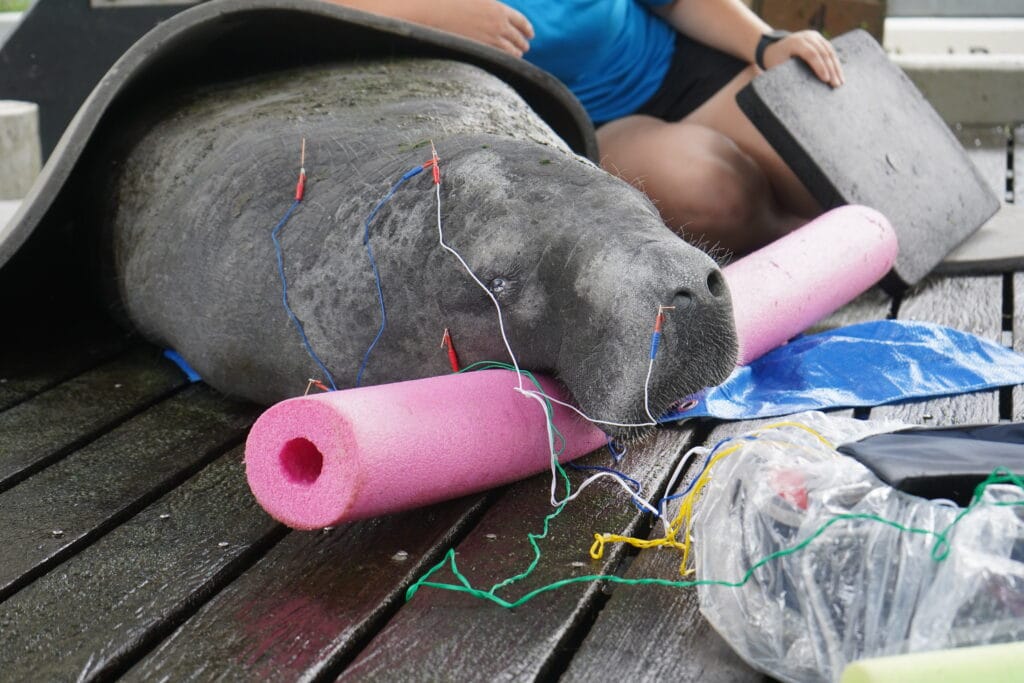
TBPM: We saw you also perform acupuncture on manatees, specifically, Sloth the manatee. What can you tell us about his case?
Dr. Mason: Sloth the manatee has been a challenging case. He came into rehabilitation for being very emaciated and suspected at some point to have likely been hit by a boat based on his injuries and general condition.
He presented with kind of a right-sided neck swelling and then facial paralysis where he was unable to open one nostril and he's unable to blink the eye on that side in addition to having no tone in the lips. So he's able to kind of eat and use his left lip normally, but the right side not as much.
So we started acupuncture on him again, just knowing how effective it can be for neurologic disorders to stimulate those nerves to wake up. And while he still has a lot of swelling and we're still monitoring his condition and treating him, he actually did have about, I would say, 30% improvement in the nostril opening with acupuncture.
While he still can't blink the eye fully, he is able to move the globe now, which was new from when he came in after a couple of treatments. So we're still working with him, and he's an ongoing case that we're hoping will continue to improve.
TBPM: Not just anyone can perform acupuncture on an animal. What training did you have to go through to be certified for this?
Dr. Mason: In order to perform acupuncture on animals, you need to either be a veterinarian or trained on humans and then have oversight from a veterinarian to practice on animals. So after finishing vet school and all the internships, I went to Chi University up in Ocala. It's a six-month program that consists of about 134 lecture hours that you have to take in addition to hands-on labs, and then time on your own memorizing the meridians and different points. So it's very intensive, lots of information, but really cool.
And when I did it, I took the mixed animal track, so I was able to do both horses and then dogs and cats. And then I knew I wanted to do mixed animal, applying it to zoo medicine since we can extrapolate from a lot of our species and so that's enabled me to then apply it.
I've previously used this a lot on goats with arthritis. In zoo medicine, we have animals that live a very long time, so whenever we’re dealing with conditions of advanced age like osteoarthritis, it can be a really helpful adjunct therapy for managing any discomfort that comes along with that.
TBPM: Why do you think it's so important that you were able to add this holistic care to the options for the animals of ZooTampa?
Dr. Mason: I think this is the first time that ZooTampa has been utilizing acupuncture in the collection, which is great because again, we're able to apply it to different cases where maybe we've exhausted a lot of our other medical treatments that we would traditionally be using, or are able to apply it to improve the overall quality of life pain management of the animals that we would otherwise be just able to monitor with our normal treatments and diagnostics.
It brings a whole new level to it and allows us to treat that patient with a more holistic approach and even more individualized care than they already receive on a day-to-day basis.
It can be so frustrating from our standpoint, from a keeper standpoint, to see animals that you care so much about not thriving. So to have another tool and be able to add one more thing and see those improvements is huge.
TBPM: It has to be a pretty rewarding experience to see an animal improve after you've administered treatment.
Dr. Mason: Yeah, I think it's been a great tool. I love it. It's one of my favorite things that I get to do here at the zoo. I like it because the animals are relaxed; they seem to enjoy it.
It's cool to talk and collaborate with the keepers and then see them get excited about the improvements and changes, so for me, it's one of the more rewarding things that I get to do. If for anyone interested, it is a lot of work up front, but I think absolutely worth it.
TBPM: What do you have your eye on next?
Dr. Mason: A lot of our animals may be more dangerous to interact with or stick needles through the bars. One of the things we're hoping to get is a laser unit so that we can actually laser acupuncture points on animals without risking putting a needle into that animal that we may not be able to get it back out of.
TBPM: Would you encourage other zoo facilities to incorporate acupuncture into their care for the animals?
Dr. Mason: For us here, the lucky thing about acupuncture is it's pretty cheap once you have the electro machine. So really all I need for overhead is just my needles, which are only a couple of dollars a box. So funding-wise, it's nice because it's easy to incorporate and it's not going to be at a significant cost to the zoo.
Hopefully funding is in the works here for a laser unit. We'll have to see how that goes in the future, but I think that’s kind of the next step in terms of continuing to expand integrative medicine here.
TBPM: Before we go, tell us more about your journey to become a zoo veterinarian.
Dr. Mason: Zoo Med is a crazy journey to kind of get to your final destination, so you have to be willing to move around a lot. I ended up at Central Florida Zoo after a rotating internship and a master's that focused on reptile reproduction, and they had a reptile breeding program for the eastern indigo snakes, so it was kind of a transition over there.
While I was there, I got certified [to perform acupuncture on animals] because we had so many animals that had a lot of chronic arthritis or a number of other problems that we were just looking for any kind of alternative solutions and they were really nice and gave me the time and let me go and supported me through the process of getting certified, and then were very willing to let me transition that over to our cases at the zoo.
TBPM: Would you recommend people bring their own pets to a veterinarian that offers integrative care for domestic animals?
Dr. Mason: I think the main thing to know is that acupuncture has very few side effects. It's generally only going to improve a patient's condition. If you're at the point with your animal of trying to just improve the level of comfort and care, I don't think there's any reason not to try it and see how it goes because I have seen really cool improvements in cases that initially, I may not have thought were going to improve, but I've seen miraculous things.
Note: Dr. Mason says you can search the Chi University's Vet Finder database to find a veterinarian near you that offers acupuncture for animals.
Related ZooTampa stories we think you'll LOVE:
- ZooTampa Baby Boom: Meet the animal keeper caring for the two new rhino zoo babies and learn more about these beautiful creatures!
- INSIDE LOOK: Florida Waters, ZooTampa's largest expansion to date, is now open!
- 10+ Ways to Upgrade Your Day at ZooTampa with Unforgettable Animal Encounters